Managing Anxiety and Knowing Your Mind
If you’re struggling with an anxiety disorder or considering therapy for anxiety, you may have wondered about a mindfulness or meditation practice. Mindfulness and meditation go hand in hand, but they don’t necessarily have to; you can do the mindfulness bit without having an actual meditation practice. Here’s how, and why it can be a good idea.
Mindfulness means observing your thoughts.
The act of mindfulness is, simply, watching your thoughts. In this way, it is indeed like certain types of meditation: The thought happens and then you send it away, like a leaf in a stream.
If you seek anxiety treatment with me, you'll probably hear me say at some point that anxiety therapy is a practice: the weekly practice of talking to someone you trust so that you can keep in close touch with your thoughts and feelings. Coming at the same time every week, for a fixed amount of time all contribute to this. It sets you up for success in finding a safe place to engage in the practice of learning your own mind. That consistency can be akin to practicing the piano, mastering a new language, or trying any other new thing you’re curious about getting good at.
Awareness of automatic thoughts helps combat anxiety.
So, how does mindfulness help with anxiety treatment? In therapy, before we can decrease the anxiety, we have to figure out what’s causing it. (There can be many causes, including organic ones, so it’s important to make sure there’s nothing medical going on.) Much of the time anxiety is, at least in part, caused by deeply rooted automatic thoughts that are causing you suffering. These thoughts can be so quick and reflexive that you don’t even realize how constantly you’re being barraged by them. What’s more, the thoughts may have even been of use at one time but are no longer serving you.
Mindfulness can be anytime, anywhere, every day.
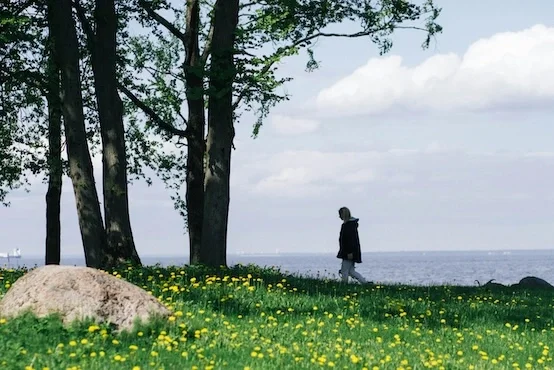
I know someone who, whenever she gets anxious, takes a walk. “The present is my best pal,” she’s fond of saying. The tactic here is to slow everything down and realize that all we really have is this moment, and then the next one. Walking is where she finds some of her best mindfulness moments, whether it’s on a San Francisco street or in a Los Angeles canyon. The next time you walk, realize where you’re looking and you’re your body is doing. Are you staring at your feet? At your phone? What happens when you stop looking at your feet, shift your gaze, and take a look at the path ahead? What happens when you stop looking down at my feet and realize there’s a path ahead of you?
Naming is taming.
“The word is the death of the thing” is an idea that has been attributed to a philosophers and poets alike. A beloved teacher of mine used to tell us the story of walking his dog, something he used to love to do every day at twilight. He’d stroll in the neighborhood, very often in the habit of stopping to bend down (he was very tall) to smell the roses in his neighbor’s garden. One evening as he was inhaling the flowers’ indescribable scent, the phrase, take time to smell the roses came to him. There’s the end of that magic, he realized. It now has words. The moment lost its power.
The same thing is true for negative feeling-states. The more we can assign them a name, the more chance we have of allowing them to lose their potency. The more we’re in touch with our own minds, the more we’re practicing mindfulness. And the better chance we have of making friends with the present and taming anxiety.
If you’re interested in learning more about anxiety therapy, why not call for a free consultation? Let’s talk about how I can help.